Showing posts with label Uruguay. Show all posts

Thursday, March 27, 2014

Uruguay, the good, the bad, and the ugly.

Many Americans (and Europeans) come to Uruguay with expectations of cheap real estate, easy residency, nice climate, inexpensive living, friendly English speaking people, private and protected banking and so on.  The good news is that the people are friendly and many speak English.

Expectations are dangerous things.  Most of the expats we have talked to have really tried to do their homework before coming all the way to Uruguay (this includes us).  Many of these people are frustrated, disgusted and are ready to relocate elsewhere.  Unfortunately, the information available about retiring or living in Uruguay comes from people that wish to sell you their services or products.

We were attracted to Uruguay for many of these same reasons.  A cosmopolitan yet inexpensive lifestyle with no visa worries sounded like a wonderful place to spend the months from November through April.  So we came here to see and this is what we have found.

·         Apartment rentals can be very expensive during the Uruguayan high season which runs December through March.  In addition, availability is severely reduced by January.  Run down forty square meter apartments in Montevideo or Colonia run between $1,100 and $1,500 per month before the cost of utilities.  Punta del Este or Piriapolous will cost significantly more.
·         You can reduce your rental cost by executing a longer term lease but expect to be asked for a deposit equal to five or six months rental.  You can reduce this deposit amount by paying the entire cost of the lease up front. 
·         There will be an immobliario (rental agent) involved and you will pay them a commission equal to 10% of the lease or one month’s rental whichever is less.
·         It is best if you can find qualified assistance for the residency process although we understand it can be done by yourself.  We have listened to story after story about law firms here in Uruguay taking thousands of dollars from people for results that are never achieved.  The process, done right, by honest people who know what they’re doing is quick, painless and inexpensive although we have been informed that the process has changed significantly with the recent change in government.
·         Bringing hard goods, vehicles, furniture or appliances into Uruguay before obtaining residency (possibly after as well) can be problematic and very expensive.  Our friends were told it would cost $300 in fees (not counting transport or insurance) to bring their vehicle into Uruguay.  One month after their vehicle arrived in port and $3,000 later they have sprung their vehicle from the customs authorities.
·         Prices for food are similar to that in the United States but more than in southern Europe.  Beer and wine costs more; a liter of the local beer costs $3 plus a $.60 bottle deposit in the grocery store as compared to $1 in Spain.
·         Restaurants are not cheap.  Beef prices appear cheaper than in the US but it can be deceptive.  Uruguayans do not age their beef similarly and the cuts are very different so it is difficult to compare.  An average meal “menu del dia” for two will cost $25 to $40 (compared to $12 to $15 in southern Spain).  If you both have a steak and share a bottle of wine you will pay $65 to $80 or more.
·         The cost of consumer goods; clothing, appliances, furniture, etc. is very high and quality is very, very low.  This is due partly to the fact that there is very little or no manufacturing in Uruguay and these items must be imported.
·         We’ve been here for December through February and the climate has been simply divine.  Daytime highs in Montevideo generally don’t exceed 27 or 28 degrees Celsius and gentle breezes blow most days.  There are occasional hot and humid days without breezes but for the most part, summer here feels like spring to us.  Because of this we expect that the winters might be fairly cold although probably mitigated by the river and the ocean.
·         There is a lively and friendly expat community in Montevideo.  There are several different groups that typically meet in the evenings or on weekends so you can get plugged in fairly quickly.
·         The buses run constantly during the day and getting around the city is relatively cheap and easy once you figure out the routes.  The bus station, Tres Cruces, is the primary place to catch buses traveling to other cities.
·         Service is an interesting thing in Uruguay.  Wait staff do exactly that; they wait until summoned.  There is also the amusing overemployment issue where there is one person for each job and that is all they do.  Nowhere is this more apparent than in a fast food joint.  The cashier takes your order and makes change.  Another person looks at the ticket and gets your sandwich.  Yet another person obtains your french fries while yet another makes your drink.  While this may not sound so bad be advised that no action is taken on any ticket until the previous ticket has been fulfilled.

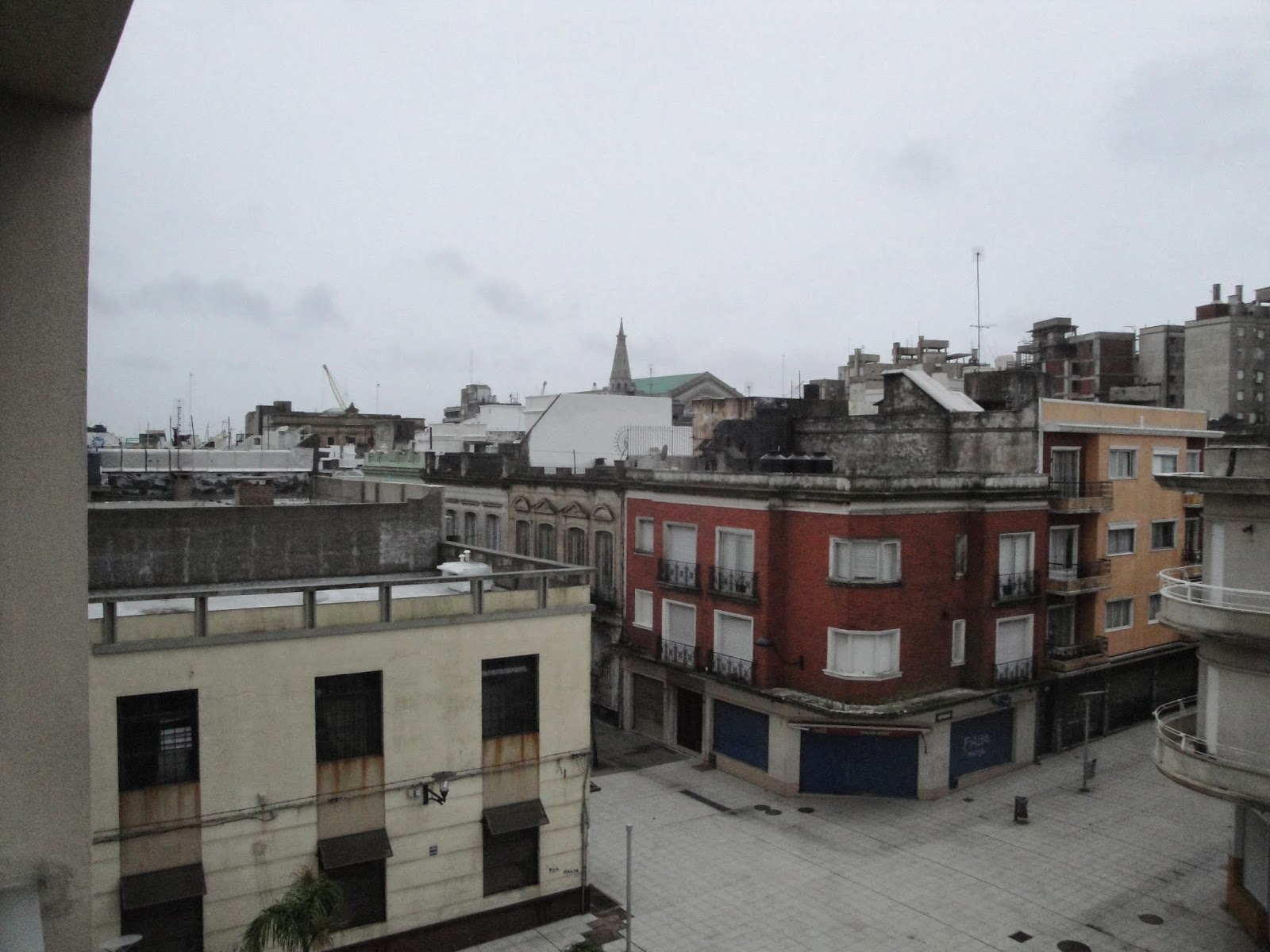
There’s much more of course.  We chose to live in Ciudad Vieja which is the old part of Montevideo and very near the port.  The streets are noisy nearly all night but the shops and other businesses close up and pull down their steel shutters by 8 pm on weekdays and earlier on the weekends.  This has the effect of making Ciudad Vieja appear to be a deserted ghetto which it is most definitely not.  We have had several people tell us (but not by anybody who has lived here for any length of time) that Ciudad Vieja is a dangerous place to live.  You wouldn’t want to be walking around alone at 3 o’clock in the morning but that would be true about most other parts of the city and in fact, most other cities.

The language is definitely different.  We are intermediate Spanish speakers and learned our Spanish in Andalucia.  Being relatively new to the language it has taken us some time to adapt to the idioma here in Uruguay.  They have trouble with our soft” c’s” and “z’s” and we struggle to hear a “y” or “ll” pronounced “sh”.  The formal “usted, ustedes” verb forms are utilized (not common in Spain) and word usage varies dramatically as well. 

Interestingly for us, many Uruguayans will answer or speak to us in English when we speak Spanish to them.  At first we thought that our Spanish was so difficult to understand that people were encouraging us to switch the conversation to English.  Later we find that this is normal and is a way for them to practice their English while we practice our Spanish although we have been told that Castellano spoken with a strong American accent is indeed difficult for most Uruguayans.  Apparently nobody needs to practice listening in their second language.

Living in the cities of Uruguay is neither cheap nor expensive.  The people are friendly and the climate benign if not absolutely divine during the summer months.  You can choose to live in a good sized city, an expensive tourist resort area, a small town or a tiny rural village.  Public transportation is good and reliable.  There are ways to avoid both problems and significant expenses once you know your way around and have connected to a few quality people.

Our advice:  Visit Uruguay once or twice before considering a commitment to living here.  Perhaps a visit in the summer and another during the winter months and stay at least a month each time.  Make connections with other expats and explore different parts of Montevideo and different parts of Uruguay.  Once you are comfortable that this is where you want to be then make a well planned, properly assisted move and avoid the costs and headaches others have experienced.  Most of all do this with your eyes wide open.


Monday, March 17, 2014

Ciudad Vieja, the "old city" in Montevideo.

We chose to stay in barrio of Ciudad Vieja (old city) in Montevideo because that’s what we do.  Our experience has been that the history and the culture of a city we haven’t been to before can be found primarily in the oldest neighborhoods.  Ciudad Vieja turned out to have a flavor all its own.

After living for three months in Ciudad Vieja we definitely have mixed feelings about this particular barrio.  There are things we really like about it and things we really don’t care for.  That is the nature of Ciudad Vieja.

At first glance, Ciudad Vieja is ugly with graffiti sprayed on the walls of the grey cement buildings and steel shutters over all the doors and windows.  Rambunctious youths talk loudly with their friends in groups around closed doorways.  Dogs wander where they like doing their business anywhere.  In the evenings most of the streets are almost completely deserted, adding to the eerie feeling you get if you first arrive after dark.

The light of day reveals another Ciudad Vieja.  Graffiti disappears as the shops roll up their shutters and open for business.  Souvenir vendors display their wares along the pedestrian only areas of Calle Sarandi and police are at every intersection.  People of the barrio go about their business carrying bags containing their morning bread, fruit and vegetable purchases. 

Ciudad Vieja has approximately 16,000 full time residents but over 100,000 workers regularly flow into this part of Montevideo on business days.  On most days there will be one or two large cruise ships in the port which adds several thousand more people to the streets.  For a while, Ciudad Vieja is crowded, noisy and vibrant.

Like any modern city that experiences the wonders of hosting tourists, there is quite a bit of petty crime.  From our apartment window we have seen two men arrested for fighting, another chased down and arrested for reasons we know not, and a local man arrested when the police were trying to walk away from him but he could not shut his mouth.  By far the most common crime is purse snatching by juvenile delinquents.

While not criminal, there are two things we have found extremely irritating about Ciudad Vieja.  The first is the number and methods of the beggars.  Hardly a child in this part of the city can bear to see a person pass without asking for money.  These are kids who are wearing nice, clean clothes with new shoes playing outside of the buildings they live in with their parents.  Please bear in mind that we have lived here for three months and I know some of these kid’s names.  At first we would ask them “why” or “for what” and the first answer was inevitably “to buy something” and when we shook our heads the answer changed to “to eat” or “for food”.  Don’t you just have pity for these kids?  Not.

The second irritating thing just grosses us out.  We have seen this happen in Pocitos and Punta Carretas (two very nice parts of Montevideo) but it is a constant in Ciudad Vieja.  The dumpster divers.  There is nothing like sitting in a cafĂ© trying to eat your wonderful and expensive chivito while facing a man eating out of a dumpster.  This is an endemic problem in Ciudad Vieja and dumpsters are rummaged through several times a day.  A regular dumpster diver (not an eater) will generally have a backpack and might be riding a bicycle.  In some ways, these regular dumpster divers are worse because they tear open garbage bags, looking for whatever they’re looking for and generally strew garbage about for the wind to blow around the streets.  We absolutely hate it. 

We stayed on the corner of Calle Perez Castellano and Calle Sarandi which is right on the edge of the tourist area.  Police stationed in the small plaza in front of our building regularly direct tourists in one of two directions (the other two directions being relatively undesirable).  Following either of the two “undesirable” directions will take you to the river and the “Rambla” which is a beautiful, wide, well paved walkway that runs for miles along the river in Montevideo.

From our apartment a walk up the Calle Sarandi will take you past several cafes and pastry shops (pastelerias) and ultimately to Plaza Constitucion (old name Plaza Matriz) which has a nice tree lined park, some fast food restaurants and two or three nice but expensive cafes.  Occasionally there will be a musical performance and there are always artists and other vendors displaying their wares.

A walk down Calle Perez Castellano toward the Mercado del Puerto has a little different flavor.  As you walk you will pass solid building with wonderful wooden doorways of many shapes and sizes.  The locals pass a good amount of their summer evenings sitting outside their residences and will respond with a cheery “buenos tardes” to your greeting.  Further down you pass a pizzeria, a butcher, a wonderful sweet shop, a grocery store and several produce stores along with a variety of other shops, markets, cafes and bars.

At the bottom of Calle Perez Castellano you will find the Mercado del Puerto which has the reputation of being the most dangerous place in Montevideo.  This is true if you are an obvious tourist, wearing a lot of jewelry and loosely carrying a purse.  This can also be true for you men if you are loosely carrying a camera (with or without case) or if you regularly keep your wallet in your back pocket while passing through crowded areas.  If you don’t insist on being a mark, Mercado del Puerto has several very nice but expensive restaurants to enjoy. 

We spent several nights a week with our friends Carlos, Selenia and Julio at El Peregrino where the parilla (barbeque) and the atmosphere are terrific.  We also particularly enjoyed the ravioli at Bebieca which is right around the corner from El Peregrino but all of the restaurants in this area have good food and are friendly.  Beware, the serving sizes can be huge in Uruguay and the parilla for two in any restaurant in Mercado del Puerto may well feed four of you.

From a practical standpoint, Ciudad Vieja is close to the port which means there is easy access to the ferries and the cruise ships.  Buses run regularly to other parts of the city most of which are within 20 to 30 minutes depending upon traffic.  It is far, perhaps a 45 minute taxi or one hour bus ride to the airport.  The main bus station, Tres Cruces, where you can catch a bus to just about anywhere in the country, is a 15 minute bus ride.  Getting around isn’t a problem.

Ciudad Vieja is also close to many of the famous Uruguayan Carnaval celebrations with the Tablados in the Mercado del Puerto open Thursdays through Saturdays, Murgas being performed every night for almost two months on the beaches in nearby Palermo and the Llamadas beginning in Barrio del Sur (an adjoining barrio or neighborhood).  Everybody simply goes to the beach for the actual holiday of Carnival.

All in all, an interesting experience.  You can stay in Ciudad Vieja with a little less spice if you rent a place near to or above Calle Zabala.  We’ve both enjoyed and hated our experience here and for us, three months has been quite enough.  We don’t need to do this again, but we’re glad we did it.  Go figure.

Saturday, March 8, 2014

Punta del Este - The Malibu Beach of Uruguay

After living in Uruguay for 11 weeks we finally got on a bus for the two and a half hour bus ride east to Punta del Este.  It was February and still in the middle of the high season in Uruguay which meant that there were very few hotel rooms available and those that were available were very expensive.  
After a bit of a hunt, we finally managed to find a nice, reasonably priced room at the Hotel Milano a couple of streets from the beach.

Punta del Este is located on a small peninsula that happens to separate the River Plata from the Atlantic Ocean.  The town is large enough to be an alternative to the big city life of Montevideo for Uruguayans and expats alike. 
From Punta del Este one can travel north and east up the Atlantic coast and visit a number of scenic, small beach villages some only accessible by four wheel drive vehicles with large, fat tires.  It is in some of these little villages where the most bohemian lifestyle in Uruguay and quite possibly in South American can be found for those so inclined.  We did not have time to explore these areas around Rocha and further north on this trip.

It rained during our entire bus ride to Punta del Este and when we arrived it was just starting to clear.  Once again the bus system in Uruguay was inexpensive (about $10), comfortable and on time.  We checked into our hotel and set off to explore this beautiful beach town.  After walking for about an hour we realized we were hungry and began looking for a restaurant for lunch.  There were many options to choose from including coffee bars, fast food restaurants, sandwhich and pizza shops and, of course, several traditional Uruguayan parillas and chivito establishments.

The sun came out while we were enjoying our lunch so we decided to continue wandering the town.  Unfortunately, the ever changing Uruguayan weather didn’t cooperate as a storm front moved past the town bringing 70 mph winds with it.  We felt as though we were being sandblasted as we attempted to take photos of Punta del Este’s famous sculpture La Mano set in the sands of the town’s beautiful Brava Beach.

Driven by the wind back to our hotel we settled in for a couple of drinks on the protected verandah and waited for the storm to pass us by.  Later we joined two friends for dinner at the lovely Virazon Restaurant located on the river walk that runs past the yacht club where we enjoyed terrific fish dishes and fresh salads.  Dinner for four with a decent bottle of wine cost about $130 which is very reasonable in Uruguay.

We only had two days in Punta del Este which for us, was probably enough.  Although the town reminded us of some of the towns along the Costa Blanca north of Alicante in Spain with twenty story apartment buildings standing along the beachfront next to entire neighborhoods of private homes the prices are significantly higher.
  A Menu del Dia for one person normally runs $25 or more compared to the 8 to 10 euro range in Spain.  Restaurants, coffee bars and shops are abundant and we saw quite a number of North Americans and Europeans crowding the streets along with the always friendly and helpful locals.  Punta del Este is a beautiful place to visit but no place to live frugally.


Monday, January 6, 2014

Western Union, Moneygram, three currencies, one apartment and too much luggage.

October was turning into a whirlwind month with all of our travel around Spain and getting ready to move to Uruguay.  The weather was still beautiful with only some occasional rain and now our friends Ash and Donna from Marbella came up to visit us.

After some frustrating cross connections on our phones we finally tracked them down at the Minotaur Bar at the bottom of the hill and we ordered, what else, bottles of Alhambra 1925 (otherwise known as “verde” or “milno” depending upon the bar and the location).  Since we started late, it was late when we turned in.

Early the next morning (for us, in Spain that’s 9 or 10) we arose and over coffee took turns taking showers.  By noon we were ready for breakfast and we set out for Puertas de las Pesas for our normal coffee, juice and tostadas.  Since it was a weekend and because Ash and Donna were there and, most importantly, because we were in Spain, breakfast was topped off with an adult beverage…..or two.  We sure like it when these two get together with us.


The weather was beautiful so we went “a tapeo” around the Albaycin starting at the top where Ash took some very nice photos at San Nicolas. 
Later we hooked up with our friends Tony and Chessa at Hannigans and ran into Kellie and Brittani while we were there.  Bacon sandwiches ensued!


Strolling back up the Albaycin we stopped for a nightcap at Puertas de las Pesas around 10 or 11 where we ran into our friend  Hassan and his lady friend and decided to go up to another friend, Ray’s place “La Terraza” for some continuing entertainment.  We picked up another friend, Nicole on the way and suddenly we were a good sized group.  It was just a normal Saturday night in the Albaycin.


At La Terraza we were joined by yet more friends and we all enjoyed great food, great conversation and the wonderful sounds of Wahdi playing his guitar.  We were all exhausted by the early morning hours and decided to call it a night although others were going to yet another after hours place.  It had been just the right amount of fun.


We said good-bye to Ash and Donna the next morning after breakfast and they returned home to Marbella while the weather was good.  We now turned our attention to our upcoming move to Uruguay.  Suddenly, we realized, that there was not much more time before we were scheduled to leave and that we were saying good-bye to friends that we might not see again for a considerable amount of time.

The practicalities of moving were upon us.  We had to get ourselves, two backpacks and four heavy (23 kilos each) duffel bags to our hotel in Venice and then to our ship.  After considering a complicated three day journey involving trains and ferries we decided that it simply made more sense to fly if….. we could travel with only one checked bag.  Enter Bag Express.  We found that for about 50 euros per bag, we could send our bags ahead to our hotel.  This was far cheaper than the several hundred euro charge for extra checked bags on the discount airline EasyJet (about 800 dollars for all four of our bags).  The only catch; we had to allow seven days for the bags to be delivered which meant that packing would have to be carefully done.

One problem solved.  Now we had to tackle another seemingly simple task but one that, in hindsight, was a preview to our Uruguay experience.  We discovered that apartment prices in Uruguay skyrocketed for the months of December through March and we finally found what appeared to be a reasonable apartment in the location we were looking for.  Now we needed to send a deposit to hold the apartment.  Simple right?

The imobliaria (rental agent) in Uruguay needed 500 US dollars sent to her but, here’s the catch; she could only accept US dollars, in cash so we were limited to MoneyGram or Western Union, both expensive solutions.  The situation was further complicated by the fact that, being in Europe, we were dealing in euros, obviously, so we were looking at getting killed at least twice on the exchange rates, and possibly three times if they insisted on sending the wire in Uruguayan pesos and then having the imobliaria convert to dollars in Uruguay.

Western Union seemed the easy solution - we could do it on line from our US bank account in dollars and avoid any currency exchange issues, perfect... right?  Wrong!  Western Union would not allow us to use their on-line service because we were not currently in the US (our IP address was alas, a Spanish one and is one more reason to obtain a VPN service) "please go in person to a Western Union office in Granada with your identification and we will be happy to help you", came the auto-response.  In the morning we headed down the hill and after over two hours of walking and three different Western Union offices we gave up in despair.  It just simply could not be done, even after one manager called their headquarters and was told they could and should do it, no one was able to make it work.  Evidently, in order to use my US bank account and send money to a foreign country I had to be either in the US or in the country I was trying to send the money to.  

The following day we dutifully went to an ATM, took out enough Euros to cover it and found the one place in the Albaycin that could send a MoneyGram to Uruguay for us, they of course, charged exorbitant fees and gave horrible exchange rates, but they did allow us to send dollars so we avoided the additional pesos to dollars conversion..

What a stupid way to do business we thought and sure enough, the imobliaria had quite a difficult time acquiring the cash after we emailed the pick-up code to her.  Why on earth wouldn't she accept PayPal or any other normal electronic payment system?  We figured it served her right, but we learned that this was more common than we thought and would come back to bite us again later.