Showing posts with label travel. Show all posts

Monday, March 25, 2013

The learning process and new decisions....


With the prospect of Mike going blind now firmly behind us and both of us working hard to get back into decent physical shape to minimize any future health issues, it was time for some hard evaluation.

We had learned that we did like being on the ground in another place and a different culture.  We had learned that the Charles Schwab checking account worked exactly as advertised and was perfect for us.  We had learned how to use Gmail and Facebook in ways that suited us.  We had learned that we absolutely hated flying long distances and we had realized we would now never be content without some significant exposure to other people and cultures in our lives.

The Peace Corps seemed like a perfect way to begin that process of living at least part of our lives outside the United States.  We continued to work on all the medical forms, made appointments for doctors, dentists, lab-work, diagnostic procedures and continued to move that process forward.  We had made the decision when we went to Spain for the TEFL course that we would live in the residencia, a far different environment than we had ever used for vacations (we had been of the 4 and 5 star resort and golf course mentality).  While it was a new experience for us it was also a rewarding one the we thoroughly enjoyed.

Our new perspective was that the Peace Corps would really take us back to our roots and help us learn to live very simply and frugally.  We started to realize that our perspective on the entire world and how we would live in it had changed.  Gone was the desire for more stuff or to recreate our American lifestyle and in its place was an insatiable curiosity about other people, places and cultures and a desire to not only see them but to live and experience life with them.

Suddenly it was time to seriously start getting rid of stuff.  We did not know exactly what the future would look like but we knew that we had some significant changes to make.  The house had to go, being a long distance land lord just did not have any appeal to us.  Getting it on the market became a priority for the summer.

First and most important we had taken the time over the holidays to explain to our two daughters what we were thinking.  They actually both thought the Peace Corps was a really cool idea and they were very happy for us.  They had mixed emotions when we told them we had decided to sell the house and that these could be the last holidays we celebrated in this house we had lived in for 17 years.  Then the really big thing….here are your sticky notes, go through the house, pretend we died, and mark anything you want to keep:  books, furniture, artwork, kitchen supplies, everything.  Difficult for them, easy for us!

We actually figured that we would need some kind of small storage unit for the things we would want to keep, thinking that we would need some furniture and maybe a few boxes of things to get restarted with when we came back to the States.  Assuming that we would leave for the Peace Corps sometime in the next 18 months as planned, we would be getting through sometime in 2014, and who knew what we would want to do at that point.

Then the real work began, with more learning, like how to use Ebay and Craig’s list, how to figure out what you should try to get for stuff you haven’t seen for 10 years,  and what charities you want to give things to that you either can’t or don’t want to sell. 

We also had to learn how to manage what we were calling our “leave behind” budget.  A storage unit, life insurance policies, property taxes, and all the other little things that we would still need to pay for even if we were living somewhere else. 

Learning new ways of dealing with each other was no small task either.  Never, in our entire married life had we spent so much time together.  We needed to work as hard on making our relationship work for both of us as we did on all the other stuff.   Two very strong personalities making tough decisions in the midst of very high stress can take a toll on any relationship and yet for us in many ways it seemed to help bring us together.  We began to see that even if we came to the answers from very different perspectives, we kept coming to the same answers.  

The idea now was to get the house on the market so hopefully it would sell by the end of the year.  Once the house sold we would become apartment dwellers, renting until time to leave for the Peace Corps assignment, whatever and whenever that might be. 

The idea of continuing to travel after our assignment just kept getting stronger.

Monday, March 11, 2013

Just a moment in Madrid, Spain


While in Granada we discussed with our friends our plans to take the train to Madrid on Saturday.  We were flying out mid-day on Sunday and wanted to avoid any last minute transportation issues.  After all, we did have to be back at work on Monday.

Everyone thought we were nuts!  They kept asking us why we were taking the train and not the bus.  Well, in our experience buses were not nearly as comfortable as trains, took a whole lot longer, and in some places you could be accompanied by all kinds of other passengers like goats and chickens that you would not want to spend hours on a bus with.  The chuckles of laughter were enough to get us to check it out.

The intercity bus system in Spain is very, very good.  The buses are very modern and equipped with restrooms on board.  They are clean and very efficient and cost a fraction of what the train does.  So we looked at the schedules, much to our surprise the bus to Madrid only took 30 minutes longer than the train and we would not have to deal with the overwhelming size and confusion of the Atocha train station.  The additional trip time is spent at a very modern travel stop where everyone gets off the bus to stretch, go to the bathroom and get something to eat or drink.  These stops are typically well equipped and might also have a book store, tourism office, cafeteria and grocery store.

Many of the buses in Spain are equipped with WiFi and some are even set up as luxury executive transportation with large seats, plugs for all your electronics; and food and drinks included in the ticket.  Even these special buses, which are double the price of a normal bus, are a fraction of the price of train tickets.  There are routes in Spain where the train is a better option because the roads are so difficult and the buses take a lot longer.  In these cases the train is worth the money.  To travel from Granada to Madrid the train was 80 euros per person and the bus was 17.  No contest!

We arrived in Madrid early afternoon and checked into our hotel, a charming small hotel just a 15 minute walk to the Prado and very near both the bus station and Atocha.  Taking a walk, we did what every self-respecting tourist should do in a new city; we found a café and sat down outside to have a bite to eat and a beer. 

Madrid is a big city, over 4 million people live there and the noise and traffic confirm it.  We knew we did not have a prayer of a chance of getting to know Madrid in one night so we decided to limit ourselves to just one thing on the agenda, the Prado museum.  We were there on a Saturday and much to our delight we discovered that the Prado opens its regular exhibits to the public on Saturday and Monday evenings for free from 6pm until they close.  The days of the week and times may change from season to season but they do this so that the residents can go and enjoy the Museum without all the groups of tourists that fill it up during the daytime hours.

The Prado is far too large and has way too many exhibits to be seen in an evening (or a week for that matter) so we picked just two artists and tried to see everything that was on display by Velazquez and Goya; after all we were in Spain.  We did manage to see most of the collections by these two wonderful Spanish artists in the three hours we were there but the closing bell rang much too soon; hours in the Prado fly by like minutes.

We had a late dinner in the hotel restaurant and slept soundly on our last night in Spain.  In the morning we had our coffee in the hotel and checked out the metro and buses schedules to the airport, we decided to relax for the morning and just take a cab.  We knew the travel back to the states would be grueling and we could not have been more right.

Flying out of Madrid was very interesting.  Additional security measures were being implemented on all flights to the US due to an elevated terrorism threat level at the time, we still don’t know why.  These security measures cause major operational problems for many airports.  The Spanish way of implementing “additional security measures” was to put all the planes that were leaving Madrid to go to the US at the very far end of one terminal and restrict access to this area by installing additional security procedures.  Once you passed through this additional security and went down to the gate area you were absolutely not allowed to leave for any reason.  There were no restaurants or shops located at this end of the terminal though water bottles were available from a vending machine, and of course, our flight was delayed by an hour.  Poor Mike, the smoking area was 20 yards outside the secure perimeter!

We were flying a US carrier that we have flown many times and never liked.  We had an eight hour flight across the water, a four hour lay-over in Philadelphia and then a five hour flight home to Phoenix.  Well, in Madrid, our flight was delayed another hour, and then another…..by the time our flight left we were exactly four hours behind schedule.  Once we got settled in our seats and got off the ground the announcement was made that one of the restrooms was not working, really….four extra hours on the ground in Madrid and they could not find a plumber?

The pilots managed to make up about 40 minutes time in flight, probably not long enough to make our connection but long enough to let us hope.  In the Philadelphia airport we found much to our delight that Spain had gone through their seasonal daylight savings time adjustment, which had not been reflected in the aircrafts schedule, and we actually had arrived in time to make our flight to Phoenix!  Clearing customs and immigration in Philadelphia we were surprised and slightly chagrined to discover that the US was now stamping an entry stamp into the passports of its own citizens.  We wonder if we’ll need an exit stamp as well.  Needless to say by the time we arrived in Phoenix we were very happy to be done with the “travel” part of traveling.

Monday, March 4, 2013

Nasrid Palaces at the Alhambra


Playing hookey from our graduation ceremony gave us the afternoon to get to the Nasrid Palaces at the Alhambra that we had missed in our first visit.  We went on-line and bought tickets a few days ahead of time so we knew we had to present ourselves at the entrance to the Palaces right at 2pm.


We had a little time to wander from the main gates through the gardens and down to the lower level where the palaces are.  The Nasrid dynasty ruled in Granada from the 11th century until the Christians conquered in the 1492.  These palaces are what are left of the original Moorish palace and many areas have been beautifully preserved and restored.

We began our tour of the palaces in the Mexuar, or the public rooms of the palace.  These areas would have been meeting rooms and the places of commerce and diplomacy.  The design of these rooms was meant to be impressive of course, to the people seeking an audience with or the services of the ruling family who were no doubt awed by the vastness of the spaces and the huge expense incurred in their design and decoration.


Islamic artwork uses geometric patterns and patterns found in nature like flowers and leaves but does not use depictions of people of animals.  The written Arabic language also lends itself to beautiful designs and words and phrases are carved everywhere.


From the Mexuar we headed into the Comares Palace (Palacio de Comares) which was the actual living quarters and private residence of the Caliph and his closest family and advisors.  It is difficult in this day and age to really comprehend how people lived at this particular time.  Many rooms had pool s and fountains with running water to help cool them in the hot summer months. Ceilings are coffered and inset with inlaid wood and painted in flowing Arabic script.  The windows and arches were designed for both strategic significance and for the views of the kingdom, and each one is fully carved and decorated from the inside so the view of the window is as beautiful as the view seen from it.

The finally the Palace of the Lions (Palacio de los Leones), this was the part of the palace that housed the harem.  The women and children lived in beauty and luxury.  The patio of the Lions is the centerpiece of this area and at the time we first visited it was closed for restoration.  We could only glimpse in through the scaffolding and plywood but what we could see was spectacular.  (The restoration work is now complete and it is absolutely spectacular!)


The tours of the Nasrid Palaces can be done many ways, we did it on our own, just purchasing tickets and reading about the things we saw.  There are Audio guides available for those that haven’t done their research and live, guided tours are offered if you want to spend the money.  The number of people admitted to the palaces is limited each day because they are trying very hard to protect and preserve them.  If you want a very different and quite romantic experience, try taking the tour at night, the views are spectacular and the groups are smaller so there is a more intimate feel to the palaces.


All in all and afternoon very well spent!  

Friday, March 1, 2013

The best Irish Pub we've found yet...


Seems like everywhere we’ve been there’s one or two self-proclaimed Irish pubs.  So, out of our own personal interest, hunger and thirst, we’re going to look for and document Irish pubs wherever we go.  We’ve been saying for years now “There’s an Irish pub in every town and if not, there’s a business opportunity”.  We’re going to have a little fun with this so please let us know if we’ve missed a candidate.  We welcome all suggestions (researching will be enjoyable). 
The first Irish pub sets the standard of course, and it sets the bar high.  To try and bring a little objectivity to this very subjective effort we propose to rate the pubs on the following scale.

1.  Ambience (1 to 3 points) – dark wood paneling and furniture, lighting, mirrors, floors, signage, etc.

2.  Irish Bartender (0 to 3 points) – a second point is available if there is more than one Irish bartender.  The third point is for a bartender that insults you while he/she serves you and you find that you enjoy it (he or she could only be Irish).

3.  Taps (0 to 3 points) – One point each for having on tap:  a) Guinness, b) Irish ale, or beer, and c) Irish cider.

4.  Kitchen (0 to 4 points) – One point each for having: a) an Irish breakfast fry-up, b) a bacon sandwich, c) a shepherd pie, and d) food quality.

5.  Entertainment (0 to 3 points) – No I do not mean “Paddy jokes”.  Fiddlers and tenors are appropriate as is futbol and hurling (on the television of course).  Bartenders count.


Located at the base of the Albayzin near Calle Elvira we are rating the original Hannigans (there are two in Granada).  We found this gem in the fall of 2010 and have been returning ever since.  We give 2 points for ambience for the dark wood, the bar and the signage.  Uncomfortable and poorly arranged seating are only a small problem.

Hannigans receives 3 points in the Irish Bartender category because Rory and John, God Bless them are both Irish and Rory is also the house master of the insult, bad jokes and on good days, part of the entertainment.

This pub scores extremely well in the Taps (3 points) and Kitchen (3 points) categories.  Guinness, Strongbow and Murphys Irish Red are all on tap although we have been considering that we should deduct one point for their also having Amstel on tap.  The kitchen is small but generates an amazing fry up, bacon sandwich and hamburger (made with Irish beef and good Irish cheddar cheese) along with a limited number of other items such as chicken wings.  They do not offer a shepherd pie.  Kitchen hours are somewhat limited (currently 1:30pm to 5:00pm weekends and 7:00pm to 10:00pm weekdays) and closed for a couple of months during the summer so you have to plan a little but it is well worth it.

Finally Hannigans receives 2 point for entertainment.  Futbol and hurling are regularly on the television and the bartenders are worth a few laughs every time.  Music is from the bartender’s playlist and requests are sometimes granted.

Summary for Hannigans:

Ambience                                2
Bartender(s)                            3
Taps                                         3
Kitchen                                   3
Entertainment                         2

Total                                        13 point of a possible 16

This is a very high standard indeed and we can’t wait to get back.  Oh and Rory, you are only worth 3 points “petal”.

Monday, February 25, 2013

The Alhambra in Granada, Spain

The Alhambra looms over Granada and is Spain’s primary tourist attraction.  This fortress has a long and rich Moorish and Christian history far beyond the scope of this blog.  We are history buffs and indulged in a lot of reading before ever seeing it first hand, for us, the place is magical.  If you plan to visit, familiarize yourself with at least a bit of the history of the Alhambra and the related history of Granada before you arrive, it will be time well spent.

On our first weekend in Granada we decided to visit the Alhambra with two of our TEFL mates (yes, one was an Aussie).  We had heard that it was best to either purchase tickets on line, in a local bookstore or at certain ATMs but we figured that early on a Sunday morning, in Spain, we should be able to easily purchase the tickets we desired.  Oooops, definitely purchase them in advance!

We hiked the very steep hill from Plaza Nueva to the Alhambra and found that a small part of the lower citadel is open to the public, a very small part.  We went in and by 11, after seeing all there was to be seen in about 30 minutes we found ourselves at the ticket counter.  Here we discovered there are two types of tickets; one ticket is for the lower citadel and includes the summer palace and gardens or “Generalife” and the other includes access to the Nasrid dynasty palaces.  The Generalife/lower citadel tickets cost 6 euro and the Nasrid palaces tickets were 12.  You could buy them both together for 16 euro.

Unfortunately, the Nasrid palaces tickets are much in demand and tour groups buy them up quickly or in advance.  These tickets provide a limited number of people access at various but specific times.  If you are not present for your entry time and miss your group’s entry, well too bad.  The first time available for purchase that day was 3:30 and we decided not to wait and wander around for more than four hours and that we’d save the Nasrid palaces for another day.  We purchased the Generalife/lower citadel tickets.

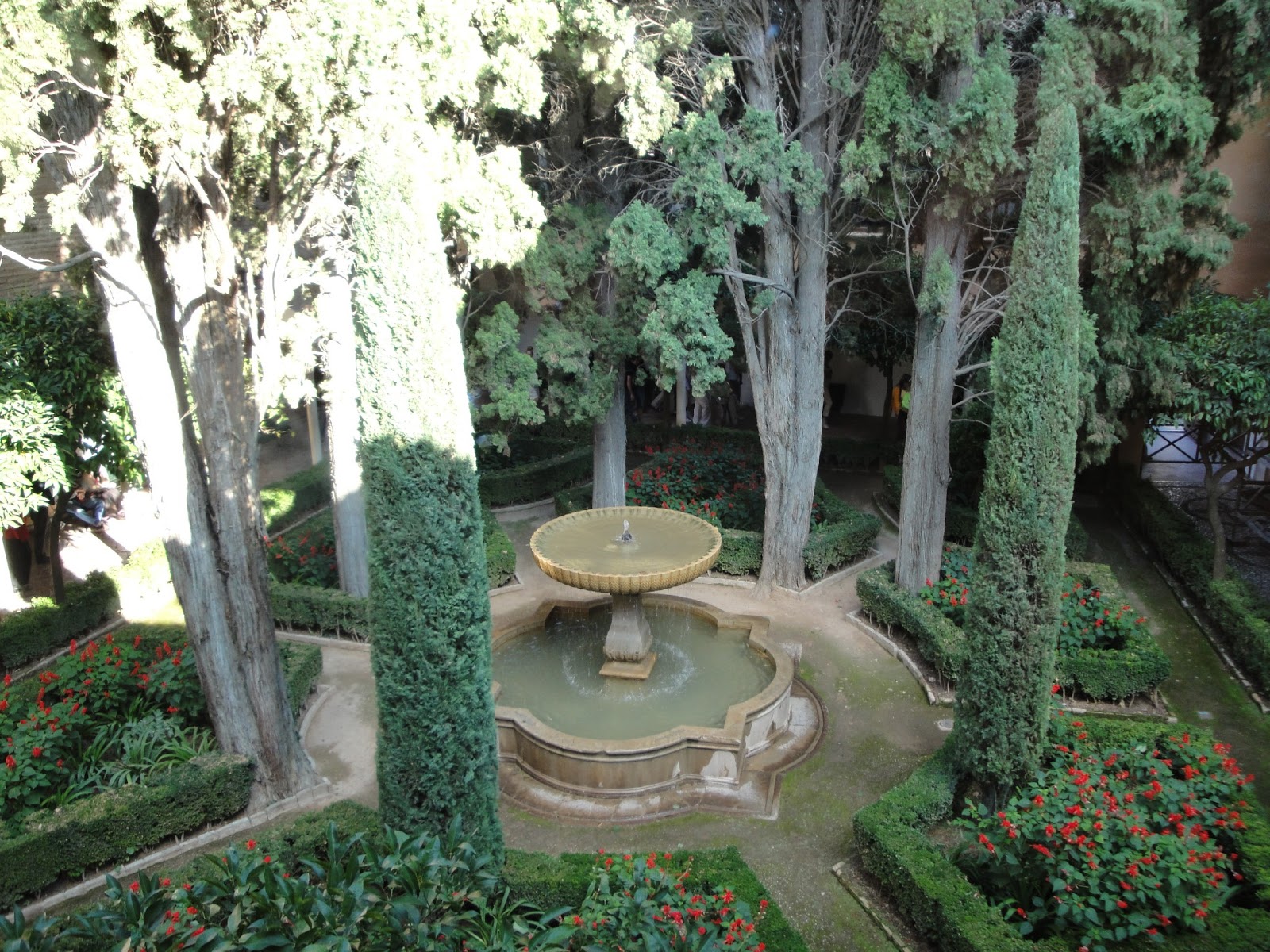
Figuring to start at the top and work our way down we climbed to the Palacio Generalife which was the Nasrid dynasty’s summer palace.  This summer palace is located a significant distance up the hill from the lower citadel and features seemingly endless gardens redolent with colorful, sweet smelling flowers and the sound of constantly running water. 

From the Generalife one can look down upon the lower citadel and view its many towers over the terraced gardens.  The city of Granada lies in the distance and the entire palace conveys a sense of tranquility and quiet contemplation.

The four of us wandered aimlessly through the gardens and simply enjoyed the fountains, pools, manicured hedges, pathways and views from the gardens and the palace windows.

 A long, curved, tree lined path led down through the palace gardens, across an arched bridge over what can only be called a moat, into the outer passageways of the lower citadel.
The walls of the lower citadel contain many breathtaking viewpoints of the Albayzin on the hill across the river Darro, of the city of Granada and of the cultivated plains beyond.

Many of the towers placed in strategic points along the walls are accessible and with a little patience, one can take advantage of a photo opportunity without other tourists in the frame.


Inside the walls, the lower citadel contains the remains of the barracks for the palace guard, a myriad of staircases linking towers to defensible areas along the walls and, of course, more gardens and fountains.  There is a basilica whose interior can be viewed when services are not being held and the huge palace of Carlos V can also be accessed with this type of ticket

The palace of Carlos V is square on the outside and circular on the inside, is two very tall stories high and has an impressive inner courtyard.  It contains a small historical museum and on this day had an exhibition of Monet paintings, for an additional entry fee of course.


By 1:30, after 3 hours of wandering this incredible structure we had had enough and exited to the forested path leading down to Plaza Nueva, the starting point for any excursion to the Alhambra.  We celebrated our tour with pints of Murphys Red and a fry up for breakfast at our favorite local Irish pub; but that’s another story. 

Friday, February 15, 2013

On to Barcelona


Barcelona.  Nice large, modern airport.  We don’t care.  It’s four o’clock in the afternoon and after 22 hours of traveling we are tired, dirty and sore.  Not brave enough to try the bus, we garnered a taxi to our hotel.

The first thing we did absolutely right was our choice of hotel location.  We stayed in the hotel H10 PlazaCatalunya at the time it was less than 100euros a night and in Barcelona that was very reasonable.  Plaza Catalunya is at the top the La Rambla and is surrounded by bus stops and metro stations.  While our room was small by our standards, it was clean and comfortable, and once we walked around outside we confirmed that we were in the middle of everything.  We took showers and a nap.

Waking up around nine in evening we thought we had lost half a day in Barcelona.  Not necessarily true.  Walking outside the streets were jam packed and everything was open.  There was a restaurant next door to our hotel that had sidewalk tables and we found one, ordered beer, wine and seafood paella; a perfect introduction to Spain.  Expensive but perfect.

Not dealing with our jet-lag very well we returned to our hotel about 1am and tossed and turned until nearly 6am when we fell soundly asleep.  Awake at noon we once again thought we had wasted half a day in Barcelona.  Again, not true.

Restaurants were serving breakfast.  The Spanish version of breakfast turns out to be very different than the American version.  Coffee as Americans know it doesn’t exist in Spain although some restaurants provide a “Café Americano”; don’t do it.  Café is some form of espresso; single, double, with milk or cream etcetera.  Tostadas are the mainstay however and can be ordered with butter, jam, ham, cheese, tomato or any combination of these.  A tostada is a small (what we in the states would call a “French bread”) toasted on a grill.  So breakfast at noon is normal in Spain; weird for us.

We spent the afternoon wandering down La Rambla, wandering through the Boqueria (a huge indoor/outdoor fresh food market) and exploring the Gothic quarter.  There were crowds but since it was October they were not bad.  We absolutely stumbled upon the Picasso museum and were astounded at the sheer volume of sketches and “blue period” pieces that were on display.  We spent the better part of two hours there.  Of course now we needed to find the famous café where Picasso hung out as a teenager in Barcelona; 4 Cats or Quatre Gats.

On the way back to our hotel we passed a guitarist playing, and playing well, in a small courtyard surrounded by 3 and 4 story buildings.  The acoustics were simply incredible and we had to stay and listen for a bit.  We walked La Rambla back to our hotel and enjoyed the many street artists performing along the way.  That evening we slept well.

The next day we planned to take the metro to La SagradaFamilia.  This cathedral was designed by Gaudi and is very different type of gothic structure.  It has been under construction since 1882 and is still not finished.  At the risk of sounding irreverent or unappreciative of art or architecture, it looks from afar like several dripping candles.  Up close however, the detail is really incredible.


Even in October the lines at the Sagrada Familia were a block long but well worth the 45 minute wait.  We had a little trouble figuring out the Metro on the way there but, an apparently homeless person helped us by showing us how to work the ticket machine and we gave him a couple of euro for his assistance.  Another skill acquired.  Be careful though, this can be a common rip off scam so never give money in advance to an individual that approaches you like this.

That afternoon we went in search of “Quatre Gats”, in the El Barri Gotic or Gothic quarter and to explore El Raval.  We found Quatre Gats and were introduced to Barcelona’s version of tapas (a snack with your beverage).  It proved a very enjoyable rest and refreshment break in an incredible atmosphere.  There were pictures and posters on the walls by various famous artists, some of them quite old and I’m sure, quite valuable.  A significant number of tourists attempted to walk in and take pictures but were redirected by the staff.  Taking pictures is okay but you must be a paying customer.


The rest of our time in Barcelona passed quickly as we wandered this beautiful city.  The weather was perfect and the food delectable.  We had become brave enough to consider taking the bus to the airport.  We’d like to say that our day of departure came too quickly but for us, 4 days in Barcelona had been sufficient.

The morning of departure we walked across the plaza to the bus stop and got on the airport bus.  Arriving at the terminal we were absolutely unable to find our airline’s check in counter.  After 30 minutes of wandering around we realized that we were in the wrong terminal and needed to catch another bus to the correct terminal.  Tired and sweaty and out of time we arrived at our check-in counter (with very long lines) just in time to hear an announcement, in Spanish of course, concerning our flight.

Turns out, our 12:30pm flight had been delayed for at least one hour.  We checked our bags to Granada and proceeded to the gate.  By 2pm our flight had been cancelled along with the 1:30pm and 2:30pm flights.  It finally looked like we would be leaving by 3:30pm.  This fit the window we had arranged to meet the person who would check us into our accommodations.

For any of you that are irritated that messages in the United States (in airports or when calling a utility company for example) are repeated in Spanish or other languages I would invite you to an airport, bus station or train station in a country in which you do not speak the language, or don’t speak it very well.  If ever there is an announcement that concerns your travel, like a boarding announcement or a gate change, you will be grateful for that English repetition, trust me.

We finally boarded our aircraft at 4:30pm.  Four consecutive flights had been cancelled because, we think, the planes weren’t filled.  But now the flight was packed and we were unable to sit together during the 90 minute flight occupying instead, middle seats in different parts of the plane.  The captain then made an announcement that the flight had “missed its’ departure” slot due to the amount of time it took the passengers to board and would be delayed for 3 more hours. 

What ensued was probably the funniest thing I have ever seen on board an aircraft that had already left the gate.  Fully 80% of the passengers stood up and started pulling down their overhead luggage.  I cannot adequately describe the sound of over one hundred angry Spaniards all talking at once.  There was going to be a mutiny right there on the taxi way.  The captain had to come out of the cockpit to reassure the passengers and at first we thought they were going to string him up or at least throw him off the plane but eventually everybody calmed down and returned to their seats. 

Interestingly, we took off 15 minutes later.

Monday, February 11, 2013

Moving forward...


Okay, now what?   We had been told that the Peace Corps application process could take 18 months to 2 years for a couple that wished to serve together.  Seems like plenty of time but there was a lot we needed to do.

First, there was the house; sell it or rent it out?  Then there was the issue of our personal property, our stuff.  Storing it all for two or three years just didn’t seem to be a good solution.  On top of this there were the endless little things we started to realize we needed to do to prepare ourselves; banking, communication, acquiring additional skills and more.

We decided we had time to figure out what we were going to do with the house.  We determined that travel abroad, for any length of time, was going to require us to make a significant improvement in our technological capability.  Complete conversion to electronic methods would be a necessity.  Our laptops were going to become more important to us, MP3 players which were unnecessary to us in our current lifestyle needed to be acquired and most importantly, we were going to need e-readers of some kind since it would be impractical to travel with a lot of books.

We also wanted to spend some time, perhaps as much as 5 or 6 weeks, immersed in another culture; just to see how we adapted or in other words, how uncomfortable we might be.  It seemed rational for us to schedule a working vacation, abroad, acquiring our Teaching English as a Foreign Language, or TEFL certificates.  This is generally a one month course and they are taught all over the world.

We chose Granada, Spain for a combination of reasons.  Our research showed that the programs offered there were some of the most rigorous in the international TEFL society.  Granada was also the home of a major university and over 40 language schools.  We didn’t want to be in a large urban environment and programs in Sardinia or one of the Greek islands seemed a little too much like a vacation rather than a serious learning experience.  We also wanted to spend time in a place with a rich history we could explore in our free time.  Granada fit the picture so we signed up.

Now we were on a schedule.  It was late July and our class started the first week of October.  We had never tried to get away for more than two or three weeks before plus we needed to implement elements of our long range plan.  We had to work out coverage for our clients and figure out how to stay in touch.  Keeping the long term plan going meant we had to start getting rid of our stuff, the books had to go.

We are voracious readers, reading several hundred books per year.  Needless to say, we had built up quite an extensive library (in excess of 4,000 books).  We took the time to list them on EBay and Half.com and started to sell them.  We almost cried when we sold the first one.  After quite a bit of research we bought Kindles, and vowed not to buy another “real” book.  With so much free and inexpensive content available for our kindles we knew we could keep our reading habit alive at a significantly lower cost.

We also bought MP3 players and started to burn our existing music to them.  We upgraded one laptop and purchased another high end but very light weight model.  At the risk of sounding Bohemian we decided that backpacks were the way to carry them and our other electronics while we traveled.   Another month of research to figure out which type and size to buy (we bought Northface but there are lots of options), then trying it out at home to be sure everything would work and we were set.

By early September we were very busy with travel and business arrangements, selling books, buying e-books and burning music.  We set up Skype accounts in order to communicate with our clients, family and friends.  Later, we were glad we had set up our Facebook page so that we could easily share our international experiences. 

There was also a major change in our banking arrangements.  While most banks (but not all) have electronic bill pay capabilities, we were facing issues like currency exchange rates and using ATMs outside of the country.  The fees and other costs could become enormous.  The solution came with Charles Schwab HighYield Investor checking.  Here we get bank exchange rates, no foreign transaction fees, all of the electronic services we needed and they refund all ATM fees charged to your account from anywhere in the world.  Wonderful!

The next thing we knew we were on an airplane.  Our short stops in Philadelphia and Madrid flew by and we found ourselves in Barcelona, Spain.